Why Your Resting Burn Barely Dropped After Losing 15 Pounds
Quick Answer: Losing 15 pounds drops resting metabolic rate by roughly 45-90 calories per day, mostly because there is less tissue to maintain. Adaptive thermogenesis adds maybe another 50-100 calories of slowdown in the short term. That is a real number, but it is nowhere near the metabolic destruction people describe online.
You lost the weight, the scale stalled, and the internet told you that you broke your metabolism. The math says otherwise, and the actual explanation is less dramatic and considerably more fixable.

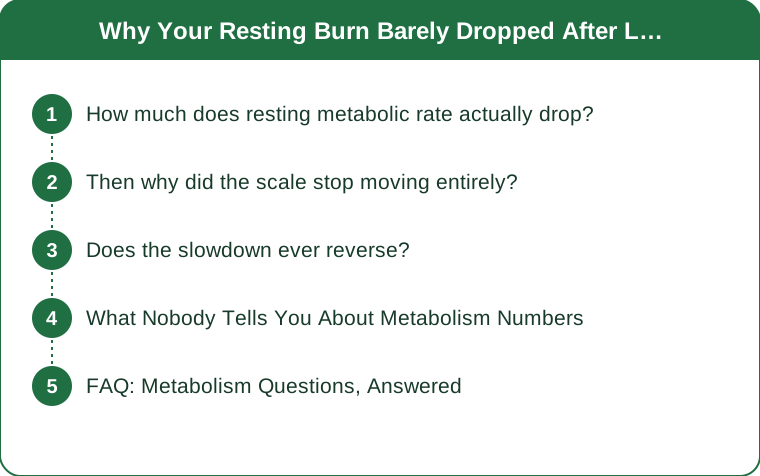
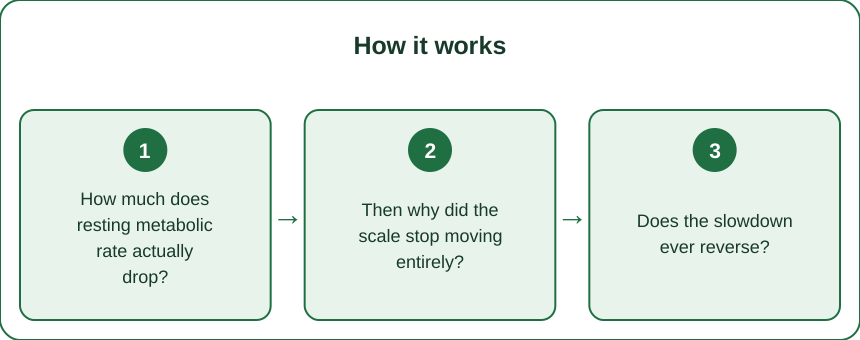
How much does resting metabolic rate actually drop?
Resting metabolic rate scales with body mass, and mostly with lean mass. Every pound of body weight you carry costs roughly 6 calories per day at rest when averaged across fat and lean tissue.
Lose 15 pounds and you shed about 90 calories per day of baseline burn. Lose 30 and it is closer to 180. That is arithmetic, not damage.
On top of that, adaptive thermogenesis kicks in: the body becomes modestly more efficient, running maybe 5-10 percent below predicted for a period after weight loss. In practical terms that is another 50-100 calories. Total: somewhere between 140 and 190 calories per day for a 15-pound loss.
Then why did the scale stop moving entirely?
Because 150 calories per day of metabolic change does not stall a 500-calorie deficit. Something bigger moved, and it is almost always one of two things.
NEAT collapsed. Non-exercise activity thermogenesis is fidgeting, walking, standing, gesturing. In a deficit it can drop by 200-400 calories per day without you noticing a single decision. You take the elevator, you sit through the phone call, you park closer.
Intake crept. Portion sizes drift upward on a slow timeline. The oil in the pan, the handful while cooking, the bigger scoop. Studies on self-reported intake consistently find under-reporting in the 20-30 percent range, and it grows over months.

Does the slowdown ever reverse?
Most of it does. The mass-related portion is permanent by definition, since a smaller body genuinely needs less fuel. But the adaptive portion recovers.
Spending a few weeks eating at maintenance restores much of the adaptive component, along with the thyroid and leptin signaling that drove it. This is the actual mechanism behind diet breaks working.
What does not help is eating less to force the scale down. That deepens the adaptive response and drives NEAT lower, which is how people end up eating 1,200 calories and stalling. The fix for a stall is usually more food and more movement, not less food.
What Nobody Tells You About Metabolism Numbers
Your fitness tracker’s calorie burn is an estimate built on population averages, and it can be off by 20-30 percent in either direction for resting burn and considerably worse for activity.
That means the number you have been chasing may never have been your number. If the tracker said 1,900 and you actually run 1,650, your “broken metabolism” is a measurement error that has been sitting there the whole time.
The other thing nobody says out loud: muscle mass buys you far less resting burn than the internet claims. A pound of muscle burns about 6 calories a day at rest, not 50. Strength training is enormously worth doing for body composition, insulin sensitivity, and bone density, but not because it turns your body into a furnace.
And protein does raise total burn measurably. The thermic effect of protein runs 20-30 percent of its calories, versus 5-10 percent for carbs and fat. Shifting 60 grams of your daily intake toward protein is worth about 40-60 calories a day, which is comparable to the adaptive slowdown you were worried about.
FAQ: Metabolism Questions, Answered
Can I permanently damage my metabolism with dieting?
No, not in the way the phrase implies. Extended aggressive dieting produces real adaptive suppression, and it recovers with sustained maintenance eating over weeks to months.
Does eating more often speed metabolism?
No. Meal frequency has no meaningful effect on total daily energy expenditure. Eat on a schedule that keeps you consistent, not one that promises a metabolic bonus.
Should I get a real RMR test?
If you have stalled repeatedly and want to stop guessing, yes. Indirect calorimetry at a clinic or sports lab costs less than most people expect and replaces a tracker estimate with your actual number.
This is general information, not medical advice. If weight changes come with fatigue, cold intolerance, or hair changes, ask a clinician to check thyroid function.
TL;DR:
- A 15-pound loss costs about 90 calories of baseline burn plus 50-100 of adaptive slowdown
- NEAT dropping and intake creeping explain most stalls, not metabolic damage
- Adaptive slowdown reverses with a few weeks at maintenance
- Tracker calorie estimates can be off 20-30 percent, so the number you are chasing may be wrong
Before you cut another 200 calories, spend two weeks tracking your daily step count alongside your food. If steps quietly fell from 9,000 to 6,000, you found your missing calories, and the fix is a walk rather than a smaller dinner.
Keep Reading
This article is for general informational purposes only and is not medical advice. Always consult a qualified health professional for guidance specific to you.