Does Cold Weather Actually Increase How Many Calories You Burn
Quick Answer: Yes, but far less than people assume, and only under specific conditions. Shivering meaningfully raises energy expenditure, sometimes several-fold for the duration, but you rarely shiver in daily life. Non-shivering thermogenesis from brown fat is real and measurable, adding on the order of tens to low hundreds of calories a day under sustained mild cold in the people who have active brown fat. Meanwhile, cold weather usually reduces total daily activity, and that reduction typically exceeds the thermogenic gain. Net effect for most people: slightly negative, not positive.
Every autumn the claim resurfaces that being cold burns extra calories. It is not wrong. It is just much smaller than the headline and it comes attached to a behavioural cost nobody mentions.
Here are the actual mechanisms and the actual numbers.

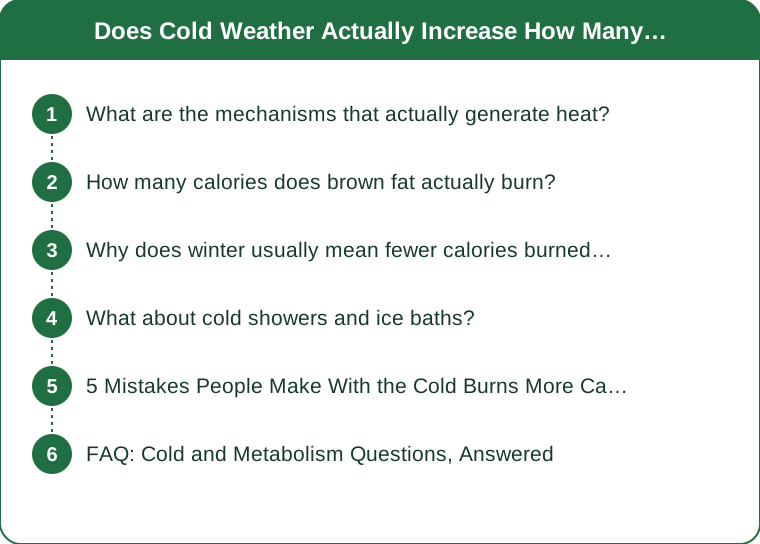
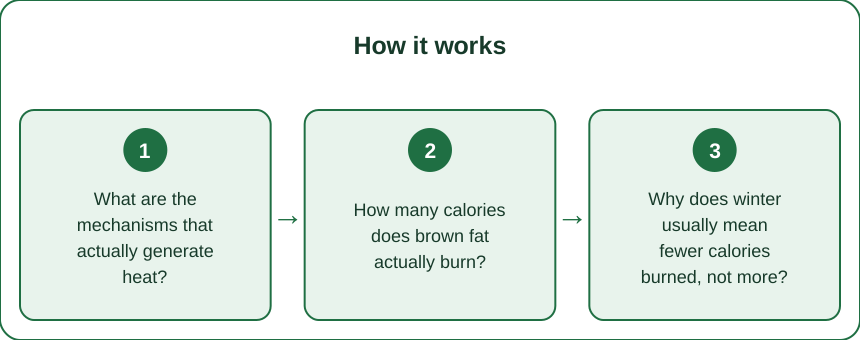
What are the mechanisms that actually generate heat?
Three, and they are very different in size and in how often they run.
Shivering thermogenesis. Rapid involuntary muscle contraction. It is expensive, raising metabolic rate by roughly two to five times resting depending on intensity. Intense shivering can approach the energy cost of moderate exercise. The catch is that it only happens when you are genuinely, uncomfortably cold, and humans are extremely good at avoiding that with clothing and heating.
Non-shivering thermogenesis. Brown adipose tissue burns fuel to produce heat directly, without doing mechanical work, via a protein called UCP1 that essentially short-circuits the normal energy pathway. Adults do have functional brown fat, mostly around the neck, collarbones and along the spine, which was a genuine surprise when it was confirmed with imaging in 2009.
Diet-induced and postural adjustments. Minor, but real. You fidget differently, and blood flow redistribution has a small cost.
The useful distinction: shivering is large but rare, brown fat is small but continuous.
How many calories does brown fat actually burn?
This is where the popular claims and the research diverge most sharply.
Studies using PET imaging during controlled cold exposure find activated brown fat contributing somewhere in the range of roughly 100 to 300 extra calories per day in adults with substantial brown fat depots, under sustained mild cold exposure of several hours.
That sounds meaningful, and it is, but read the conditions. Sustained mild cold in these studies usually means hours at around 16 to 19C wearing light clothing, which is not most people’s normal winter.
And the variation between individuals is enormous. Brown fat volume varies by an order of magnitude between adults, is higher in younger people, higher in leaner people, and higher in people regularly exposed to cold. A meaningful proportion of adults have very little detectable active brown fat at all.
Some estimates for typical real-world winter conditions with normal clothing land closer to an extra 20 to 60 calories a day, which is within the noise of everyday variation and well below the accuracy of any tracking device you own.
Can you build more brown fat?
Repeated cold exposure does appear to increase brown fat activity over weeks, and cold acclimation studies show measurable increases. Whether that translates into meaningful weight change is much less clear.
Why does winter usually mean fewer calories burned, not more?
Because behaviour swamps physiology, and this is the part the calorie-burn headline always omits.
NEAT falls in cold weather. Non-exercise activity thermogenesis, the calories from walking, standing, fidgeting and general movement, is the most variable component of daily expenditure and it can differ by several hundred calories a day between an active day and a sedentary one. Cold, dark, wet weather reliably reduces it. Fewer walks, more sitting, shorter outings, more time indoors.
Daylight hours shrink. Evening walks stop. Morning runs get moved indoors or skipped. This is a scheduling effect rather than a motivational one and it is very consistent.
Clothing eliminates the cold stimulus. A coat, gloves and a heated house mean your body never actually experiences the cold that would trigger thermogenesis. You get the behavioural cost without the physiological benefit.
Food intake tends to rise slightly. Modest, but the direction is consistent in seasonal intake studies.
Put those together and a typical autumn-to-winter transition is net negative for energy balance, usually by a couple of hundred calories a day, driven almost entirely by the movement change. The brown fat contribution is real and is simply too small to offset it.

What about cold showers and ice baths?
Popular, and the honest assessment is mixed.
The acute burn is small. A five to ten minute cold shower raises energy expenditure during and briefly after, but the total is modest, plausibly in the range of 10 to 50 calories. Adding a rewarming period with shivering increases it, but not dramatically.
The adaptive effect is more interesting than the acute one. Repeated cold exposure over weeks does appear to increase brown fat activity and cold tolerance, which is a genuine physiological change. Whether this produces meaningful body composition change in humans is not established.
The compensation problem applies here as everywhere. People who get very cold often eat more afterwards and move less while rewarming. Appetite responses to cold are real.
And for people training: cold water immersion immediately after resistance training appears to blunt some of the adaptive response to that training. If you lift, separate cold exposure from your sessions by several hours.
The reasonable summary: cold exposure has plausible metabolic and possibly cardiovascular and mood benefits, and is a poor weight management strategy. If you enjoy it, keep doing it for the other reasons.
5 Mistakes People Make With the Cold Burns More Calories Idea
Treating it as a licence. The number that gets quoted is usually a best case from a controlled study, applied to a person in a warm coat in a heated building. Assuming a few hundred extra calories a day that are not happening produces a predictable outcome over a season.
Ignoring the activity drop. This is the largest term in the equation and it moves in the opposite direction. A person who walked 9,000 steps in September and 5,000 in December has lost far more than brown fat could ever add.
Believing a tracker on this. Wearables estimate expenditure from heart rate and movement. They do not measure thermogenesis at all, and their absolute calorie numbers carry substantial error even for exercise. They cannot detect this effect, so any change you see in winter numbers is measuring your activity, not your heat production.
Underdressing on purpose during exercise. Training cold increases injury risk, reduces performance and reduces training quality, and the thermogenic gain is trivial compared to the training you lose. Dress for the second half of the session, not the first five minutes.
Missing the actual seasonal lever. The intervention that matters in winter is protecting movement, not chasing thermogenesis. Booking indoor sessions, moving walks to daylight, and treating step count as something to defend rather than something that happens are worth an order of magnitude more than the cold.
FAQ: Cold and Metabolism Questions, Answered
Do people in cold climates have higher metabolic rates?
There is some evidence of modest differences with long-term cold acclimation, but the effect is small and confounded by body size, diet and activity. It is not a large lever.
Does being cold at night burn more calories?
Sleeping in a cooler room, around 19C, has been associated with increased brown fat activity in small studies. The effect on expenditure is modest. Sleeping cooler generally improves sleep quality, which is a better reason to do it.
Is brown fat something I can increase deliberately?
Regular mild cold exposure appears to increase its activity, and exercise may also contribute through a related pathway. Neither has been shown to produce meaningful weight change on its own.
Does drinking cold water burn calories?
Yes, and the amount is trivial. Warming 500ml of ice water to body temperature costs about 17 calories. Drink it for hydration, not arithmetic.
This is general information, not medical advice.
TL;DR:
- Cold does increase energy expenditure, through shivering (large but rare) and brown fat thermogenesis (small but continuous).
- Realistic real-world contribution is roughly 20 to 60 calories a day, not the hundreds often quoted, and it varies enormously between people.
- Winter activity drops usually exceed the thermogenic gain, making the season net negative for most people.
- Cold showers and ice baths have other plausible benefits and are a poor weight management tool.
The seasonal lever worth pulling is not being colder. It is defending your daily movement through the months when it quietly disappears, because that is where the hundreds of calories actually live.
Keep Reading
This article is for general informational purposes only and is not medical advice. Always consult a qualified health professional for guidance specific to you.