How Much Does Your Menstrual Cycle Actually Change Your Daily Calorie Burn?
Quick Answer: Resting metabolic rate rises roughly 5 to 10 percent in the luteal phase - typically around 80 to 150 extra calories a day for most women - driven by progesterone’s thermogenic effect. Appetite in the same phase commonly increases by considerably more than that, which is why the luteal phase often coincides with a surplus rather than a deficit. Body temperature rises about 0.3 to 0.5°C, which is also why training feels harder in heat during that window.
You are told your metabolism speeds up before your period, and separately told not to eat more before your period.
Both are roughly true, and the gap between the two numbers is the entire practical story.

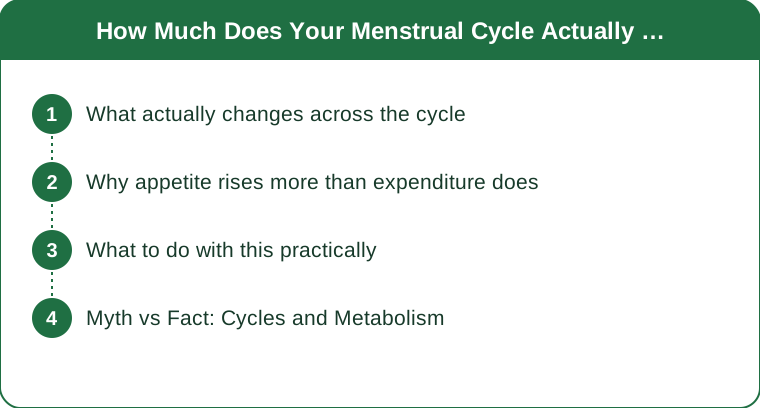
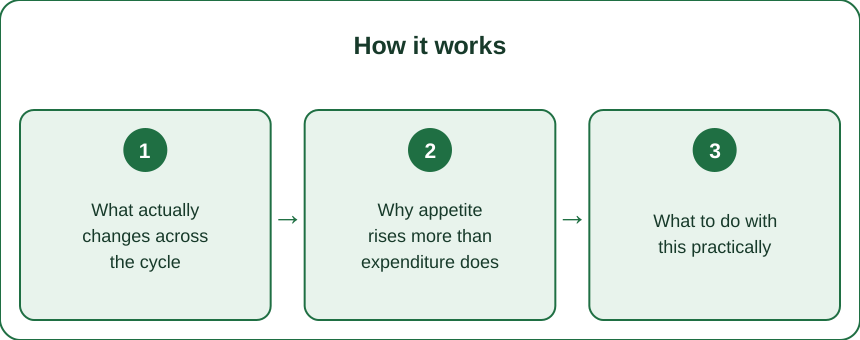
What actually changes across the cycle
Resting metabolic rate is lowest in the follicular phase - the first half, from menstruation to ovulation - and rises through the luteal phase after ovulation. The typical measured difference is around 5 to 10 percent, though individual variation is wide.
Progesterone is the main driver. It has a thermogenic effect, raising core body temperature by roughly 0.3 to 0.5°C after ovulation, and that temperature rise is part of what the extra energy expenditure represents.
In absolute terms, that is about 80 to 150 calories a day for most women, which is real but roughly equivalent to a large apple and a handful of nuts. It is not a licence and it is not nothing.
Substrate use shifts too. The luteal phase tends toward slightly greater fat oxidation at rest and lower carbohydrate availability during hard exercise, which is one proposed reason high-intensity sessions can feel harder in that window.
Water retention masks all of it on the scale. Two to four pounds of fluid shift across the cycle is common, which means weight measurements taken at different cycle points are not comparable - compare the same phase month to month instead.
Why appetite rises more than expenditure does
Luteal phase appetite increases have been measured at 90 to 500 extra calories a day, with substantial individual variation. The upper end of that range comfortably exceeds the metabolic increase, which is the arithmetic behind the common experience of a premenstrual surplus.
The drive is hormonal, not a failure of will. Progesterone and the fall in estrogen influence serotonin and appetite-regulating signalling, and cravings for carbohydrate specifically are a well-documented feature rather than a personal weakness.
Blood sugar regulation shifts slightly too, with modestly reduced insulin sensitivity in the luteal phase for many women, which can amplify the sense of hunger between meals.
The useful response is structural rather than restrictive. Increasing protein and fiber in that week, keeping meals regular, and planning for a modest genuine increase in intake tends to work far better than trying to hold the follicular-phase pattern by willpower.
Restricting harder in the luteal phase is the common approach and the one that backfires most reliably, because it usually precedes exactly the kind of episode people are trying to avoid.

What to do with this practically
Track weight and measurements by cycle phase, not by week. Comparing this month’s luteal phase to last month’s luteal phase removes most of the noise that makes progress look nonexistent.
Plan a modest increase of around 100 to 150 calories in the luteal phase, weighted toward protein and fiber. It matches the metabolic change and takes the edge off the appetite change without producing a surplus.
Expect training to feel harder in heat during the luteal phase, since core temperature is already elevated. Late summer sessions in that window genuinely are harder, and adjusting intensity rather than pushing through is reasonable.
Use the follicular phase for harder training blocks if your schedule allows, which many athletes do informally. The evidence for formal cycle-based periodization is still developing and individual response varies enormously, so treat it as a preference rather than a rule.
Hormonal contraception changes all of this, often flattening the cyclical variation substantially, so the pattern above may not apply if you use it.
And if symptoms are severe - if appetite, mood, or pain in the luteal phase significantly disrupt your life - that is worth discussing with a doctor rather than managing alone. This is general information, not medical advice.
Myth vs Fact: Cycles and Metabolism
Myth: you burn hundreds of extra calories before your period. Fact: the measured increase is typically 80 to 150 calories a day. Real, modest, and considerably smaller than the appetite change that accompanies it.
Myth: cravings are a discipline problem. Fact: they track measurable hormonal changes in appetite signalling, and treating them as a character flaw is both inaccurate and counterproductive.
Myth: the scale going up before your period means you gained fat. Fact: it is fluid, routinely two to four pounds, and it resolves within days of menstruation starting.
Myth: you should train hardest when you feel strongest. Fact: broadly reasonable, but the research on cycle-based training periodization is genuinely mixed and individual variation is large. Feel is a better guide than a chart.
Myth: everyone experiences the same pattern. Fact: variation between women in both the metabolic and the appetite change is wide enough that population averages describe very few individuals precisely. Your own tracking beats any general figure, including these.
TL;DR:
- Resting metabolic rate rises about 5 to 10 percent in the luteal phase, roughly 80 to 150 calories a day.
- Appetite in the same phase commonly rises by more than that, which is why the window often produces a surplus.
- Core temperature rises 0.3 to 0.5°C, making hot-weather training genuinely harder in that phase.
- Compare weight and measurements phase to phase across months, not week to week - fluid shifts of two to four pounds are normal.
- Plan a modest planned increase weighted toward protein and fiber rather than restricting harder.
Hormonal contraception often flattens this pattern entirely. Severe luteal symptoms are worth raising with a doctor - this is general information, not medical advice.
Keep Reading
This article is for general informational purposes only and is not medical advice. Always consult a qualified health professional for guidance specific to you.