Why Your Metabolism Doesn't Actually Slow Down the Way You Think It Does After 40
Quick Answer: Large-scale metabolic research (notably a major 2021 Science study analyzing thousands of people) found metabolism stays relatively stable from your 20s through your 50s, and only starts declining meaningfully after 60 — meaning the common ‘40 and it’s all downhill’ narrative doesn’t match the actual data, and weight changes around 40 are more often explained by muscle loss and activity changes than a slowing metabolic rate itself.
‘My metabolism slowed down after 40’ is one of the most repeated explanations for midlife weight changes — and one of the least supported by the actual research on how metabolic rate changes with age.

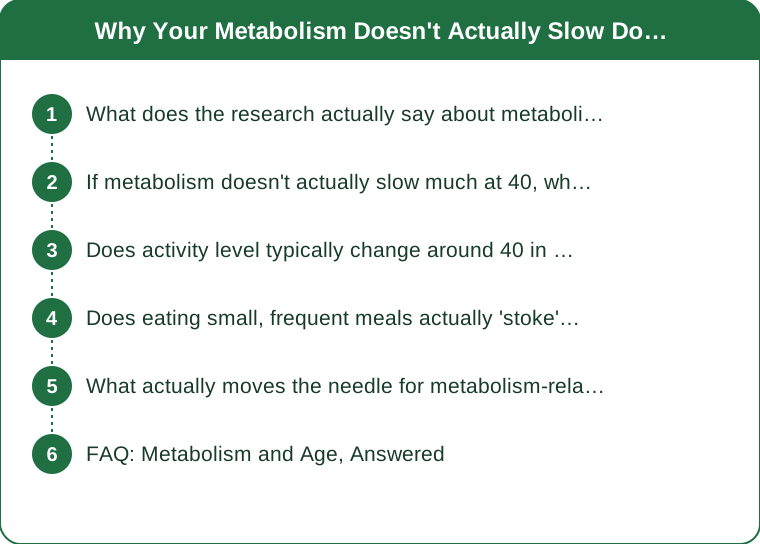
What does the research actually say about metabolism and age?
A large 2021 study published in Science, analyzing energy expenditure data from over 6,400 people across a wide age range, found that metabolic rate (adjusted for body size and composition) remains remarkably stable from the 20s through the 50s, with a notable decline only beginning after age 60. This directly contradicts the popular assumption that metabolism starts dropping meaningfully at 40.
If metabolism doesn’t actually slow much at 40, why do so many people gain weight around then?
Muscle mass naturally declines with age if not actively maintained through resistance training, and since muscle tissue burns more calories at rest than fat tissue, a gradual, unaddressed loss of muscle mass over years can lower total daily calorie burn — but this is a muscle-mass story, not a fundamentally ‘slowing metabolism’ story, and it’s addressable through strength training in a way a hardwired age-based slowdown wouldn’t be.
Does activity level typically change around 40 in ways that matter more than metabolism itself?
Often yes — career demands, family responsibilities, and general lifestyle shifts frequently reduce incidental daily movement (NEAT) around this life stage more than most people realize, and NEAT accounts for a meaningful portion of total daily calorie burn, often more than structured exercise itself for many people.

Does eating small, frequent meals actually ‘stoke’ metabolism the way it’s often claimed?
No — this is one of the more persistent metabolism myths. Total daily calorie intake and macronutrient composition matter far more for metabolic and weight outcomes than meal frequency; eating 3 meals or 6 smaller ones produces essentially the same metabolic effect when total intake is equal.
What actually moves the needle for metabolism-related concerns after 40?
Maintaining or building muscle mass through regular resistance training is the single most well-supported lever available, since it directly addresses the muscle-loss mechanism that’s the real driver behind many age-associated metabolic concerns — more so than any specific food, supplement, or eating pattern marketed as a ‘metabolism booster.’
FAQ: Metabolism and Age, Answered
Does this mean weight gain after 40 has nothing to do with metabolism?
Not nothing — but the mechanism is more about muscle mass and activity changes than metabolism spontaneously ‘slowing down’ as a fixed age effect, which is the more actionable distinction.
Do cold showers or cold water actually meaningfully boost metabolism?
Any effect is minor and short-lived compared to the impact of muscle mass and overall activity level — worth doing if you enjoy it, but not a meaningful metabolism strategy on its own.
At what age does metabolic rate actually start declining according to the research?
The 2021 Science study found the first significant decline beginning around age 60, not 40 — a full two decades later than commonly assumed.
TL;DR:
- Large-scale research shows metabolic rate stays stable from the 20s through the 50s, declining meaningfully only after 60
- Muscle mass loss (if unaddressed) lowers calorie burn more than any inherent metabolic slowdown at 40
- Reduced incidental daily movement (NEAT) after 40 often matters more than most people realize
- Resistance training to maintain muscle mass is the most well-supported lever for metabolism-related concerns at any age
If weight has shifted since 40, the muscle-and-activity story is more useful — and more fixable — than blaming a ‘slowing metabolism’ that the research says isn’t actually happening yet.
Keep Reading
This article is for general informational purposes only and is not medical advice. Always consult a qualified health professional for guidance specific to you.