How Much Does Muscle Really Raise Your Metabolism? The Honest Math
Quick Answer: A pound of muscle burns roughly 6-10 calories a day at rest — not the mythical 50. But the resting number misses the real effect: training itself burns calories, muscle makes activity more expensive (in a good way), and strength preserves your metabolic engine during dieting and aging. Build muscle for the system, not the per-pound sticker.
The ‘50 calories per pound’ claim promised that 10 pounds of muscle would torch 500 daily calories while you napped. The actual physiology pays out about a tenth of that at rest — and yet lifting is still the best metabolic investment available. Both things are true; here’s how.

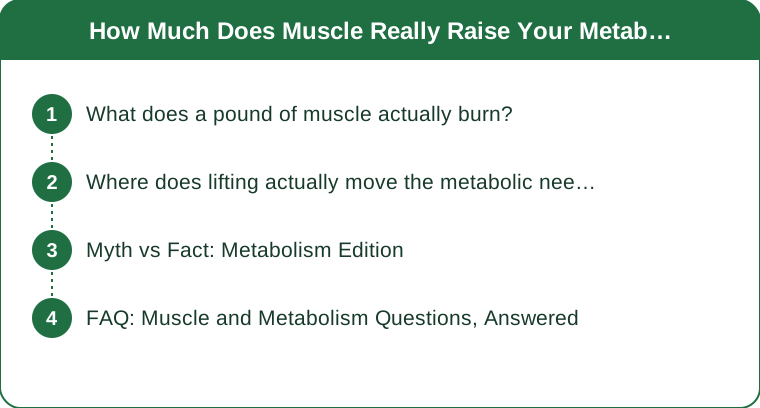
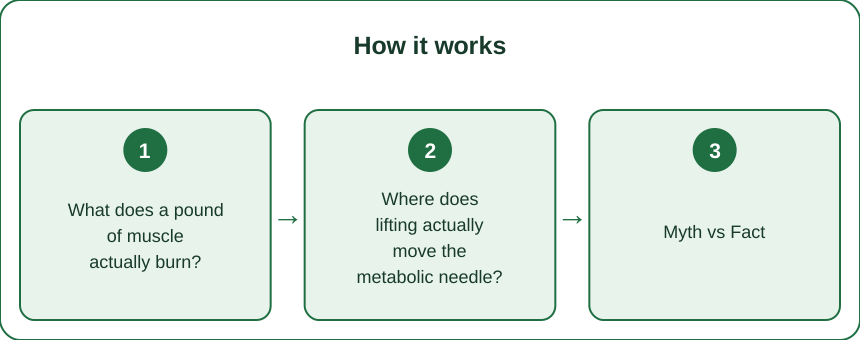
What does a pound of muscle actually burn?
At rest, roughly 6-10 calories per pound per day — versus about 2 for a pound of fat. So gaining 5 pounds of muscle (a solid year-one achievement for most women) raises resting burn by maybe 30-50 calories daily. A small apple.
Disappointing? Only against the myth. The organs quietly dominate resting metabolism — liver, brain, heart, kidneys burn hundreds of calories daily between them. Muscle’s resting rate was never going to headline.
But ‘resting’ is the wrong ledger for muscle, because muscle is the only metabolically active tissue you can meaningfully grow and use on demand — and using it is where the numbers get interesting.
Where does lifting actually move the metabolic needle?
Four compounding channels:
- The sessions themselves: a solid 45-minute strength workout runs 150-300 calories, plus a modest post-exercise elevation for hours after.
- Activity gets more expensive: more muscle moving your body costs more per stair, per walk, per grocery haul — a per-movement surcharge the resting math never counts.
- Diet protection — the big one: in a calorie deficit without lifting, up to 20-30% of weight lost can be lean mass, permanently lowering your burn and setting up the classic rebound. Lifting + adequate protein keeps loss overwhelmingly fat, protecting the engine while the fuel drops.
- Aging defense: muscle declines 3-8% per decade from your 30s untouched — the quiet reason ‘metabolism slows with age.’ Training doesn’t just pause that; it can reverse it.
The honest pitch: lifting won’t let you eat free pizza at rest. It makes every future diet work better, every daily movement cost more, and every decade steal less.

Myth vs Fact: Metabolism Edition
Myth: A pound of muscle burns 50 calories a day. Fact: 6-10. The 50 number appears to have come from dividing whole-body metabolism wrongly, and it survives because it sells gym memberships. The truth sells them too — it’s just longer.
Myth: Cardio boosts metabolism more than lifting. Fact: Cardio burns more during the session; lifting is what protects and builds the tissue that determines your baseline over years. Different tools — but only one of them compounds.
Myth: Metabolism crashes at 40. Fact: Recent large analyses show resting metabolism holds surprisingly steady from roughly 20 to 60 when adjusted for body composition — the midlife shift is mostly lost muscle plus reduced activity, both trainable. The calendar was framed for a crime the couch committed.
That last one deserves the open loop it just closed: the ‘slowing metabolism’ most people fear is roughly 80% behavior, and behavior has a barbell-shaped solution.
FAQ: Muscle and Metabolism Questions, Answered
How much muscle can I realistically gain in a year?
A consistent beginner woman lifting 2-3x weekly with adequate protein: commonly 5-10 pounds in year one, slowing after. That’s 30-100 daily resting calories plus all four compounding channels — real, just not infomercial-real.
Should I bulk to build metabolism?
No need for dramatic phases — training near maintenance calories with 0.7-1g protein per pound of bodyweight builds steadily for most beginners. Aggressive surpluses mostly speed up the fat half of the equation.
Does muscle keep burning after 40, or is it too late to start?
It works at every studied age — including studies of lifters starting in their 60s-80s gaining meaningful strength and mass. ‘Too late’ is the myth’s evil twin; the tissue responds whenever you ask.
TL;DR:
- Real number: 6-10 calories per pound of muscle daily at rest — the 50-calorie claim is myth
- The payoff is the system: session burn, costlier daily movement, diet protection (keeping loss fat instead of muscle), and aging defense
- ‘Metabolism dies at 40’ is mostly lost muscle + lost movement — both trainable at any age
- Lift 2-3x weekly, protein 0.7-1g/lb, and let the channels compound
Muscle is a bad space heater and a great insurance policy — buy it for the right reason and it never disappoints.
Keep Reading
This article is for general informational purposes only and is not medical advice. Always consult a qualified health professional for guidance specific to you.