Your Metabolism After 40: What Actually Slows Down (Hint: It's Not What You Think)
The ‘metabolism crashes at 40’ story has a problem — the landmark research found metabolic rate holds remarkably steady from 20 to 60 — which means midlife weight change has different drivers, and better levers, than the story suggests. The honest after-40 guide.


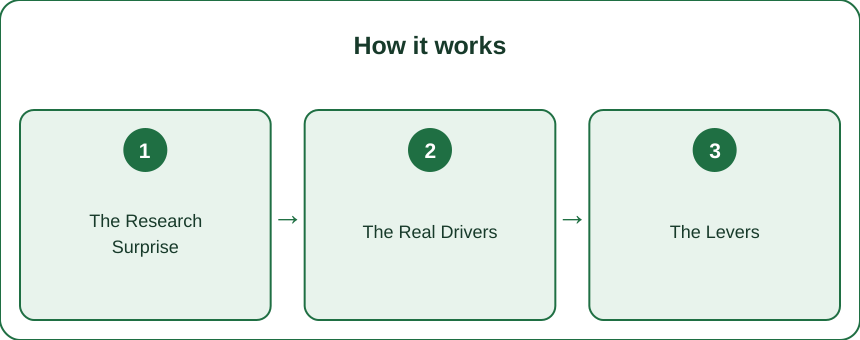
The Research Surprise
What the science actually found: the Pontzer-study headline (the large cell-metabolism analysis finding adjusted metabolic rate stable from roughly 20 to 60 — the celebrated ‘slowdown’ not appearing until the sixties; the myth’s foundation quietly removed), the adjustment key (the per-tissue stability meaning changes track body COMPOSITION — the muscle lost being the metabolism lost; the organ that burns leaving, not slowing), the honest nuance (the individual variation being real — the medical tier: the thyroid chapter’s testing logic for the unexplained; the menopause-transition redistribution effects from the hormone chapters being about fat placement more than burn rate), and the reframe (the question shifting from ‘why did my metabolism slow’ to ‘what changed in my muscle, movement and life’ — the answerable version).
The Real Drivers
What actually changes at midlife: the muscle drift (the 3-8%-per-decade sarcopenia from the muscle-aging doctrine — the metabolic engine shrinking by disuse; the driver with the clearest fix), the NEAT collapse (the non-exercise movement quietly falling — the career desk years, the drive-everywhere life; the thousand daily calories of fidget-walk-and-stairs that thirties life included and forties life deleted), the life-load eating (the stress-and-sleep-deprivation appetite effects from the cortisol chapters — the convenience eating of the overloaded decade), the alcohol-and-evening drift (the wind-down glasses and later dinners that crept — the audit nobody wants), the sleep debt (the short-sleep hunger-hormone shifts from the sleep chapters — the appetite dial turned by tiredness), and the compassion note (none of these being moral failures — the decade’s structure, not the person; the drivers named so the levers can be pulled).

The Levers
What actually responds: lever one — the muscle rebuild (the twice-weekly progressive lifting from the muscle-organ doctrine — the engine re-grown; the after-40 prescription scaled UP per the masters chapters), lever two — the NEAT restoration (the walking base, the stairs, the movement snacks from the desk chapters — the daily-life burn rebuilt structurally; the step-count floor as the honest metric), lever three — the protein anchor (the 25-30g per meal from the protein doctrine — the satiety-and-muscle double; the breakfast dose especially), lever four — the sleep repair (the seven-plus hours as appetite regulation — the sleep chapters as weight-management reading), lever five — the alcohol-and-evening audit (the liquid calories and late eating honestly counted — the gentlest-effective trims from the drinks chapters), and the non-lever honesty (the metabolism-boosting teas, supplements and hacks from the myths chapter — the market selling solutions to a problem the research redefined).
The Practical Close
The forties plan: the priority order (the lifting and walking first — the composition-and-NEAT levers with the biggest handles; the diet polish after the movement foundation), the timeline honesty (the composition change measured in months — the patience calibration from the plateau doctrine; the scale supplemented by the strength-and-measurements dashboard), the medical checklist (the thyroid, perimenopause and medication conversations for the unexplained — the doctor visit that rules out the exceptions), the identity reframe (the forties body as buildable, not doomed — the masters-athlete evidence; the decade entered as a training age, not an expiration), and the myth-retirement ceremony (the ‘my metabolism died’ explanation replaced by the honest, fixable list — the muscle, movement, sleep and stress levers all in reach; the research that took away the excuse and handed back the controls). Lift twice, walk daily, protein every meal, sleep seven: the engine, rebuilt — not mourned.
The landmark research says metabolic rate holds steady from 20 to 60 — what changes is muscle, daily movement, sleep and stress. Lift twice weekly, rebuild the walking base and anchor protein: the levers work because the engine never actually broke.
Keep Reading
This article is for general informational purposes only and is not medical advice. Always consult a qualified health professional for guidance specific to you.