Are At-Home Metabolic Testing Devices Actually Worth the Money?
Quick Answer: Consumer-grade at-home metabolic testing devices generally provide a rough estimate rather than a lab-accurate measurement of resting metabolic rate, with error margins that can meaningfully shift calorie targets — a validated online calculator using body stats is often just as useful for most people’s practical purposes.
The idea of breathing into a handheld device and getting your exact personal metabolic number is appealing, but the accuracy behind that number is a lot less precise than the marketing suggests.

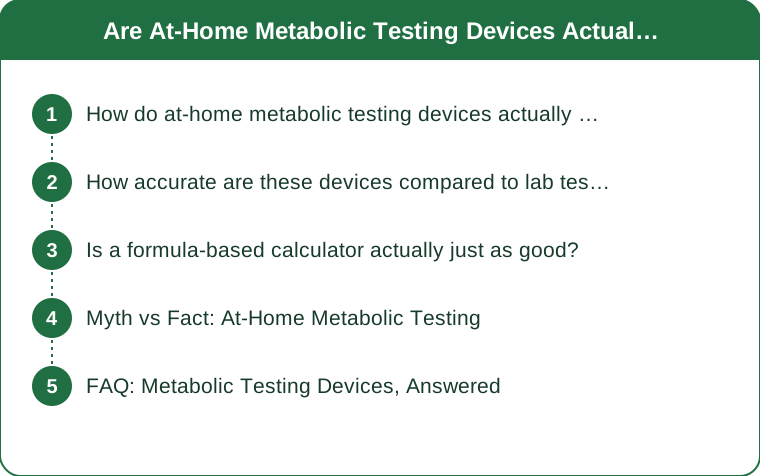
How do at-home metabolic testing devices actually work?
Most consumer devices estimate resting metabolic rate (RMR) by measuring oxygen consumption through a breath sample, using the principle that the body’s oxygen use correlates with calories burned at rest. This is the same underlying principle used in clinical-grade indirect calorimetry — the gold-standard lab test — but consumer devices use simplified, less precise sensors and shorter measurement windows than the clinical equipment.
The shortened measurement time and lower-grade sensors are where most of the accuracy gap comes from — clinical tests typically require a longer, controlled resting period in a quiet setting, which most home tests can’t fully replicate.
How accurate are these devices compared to lab testing?
Independent comparisons have generally found consumer devices show a meaningful margin of error compared to clinical indirect calorimetry, sometimes off by a notable percentage in either direction. That margin matters practically — a calorie target built on a resting metabolic rate that’s off by even 100-150 calories compounds into a real difference over weeks of tracking toward a weight goal.
This doesn’t mean the devices are useless — a rough estimate still beats total guesswork for some people — but it does mean treating the number as a precise, unchanging fact is where people run into trouble.

Is a formula-based calculator actually just as good?
For most non-clinical purposes, yes. Standard equations (like Mifflin-St Jeor, widely used in nutrition research) estimate resting metabolic rate from age, sex, height, and weight, and have been validated against clinical measurement across large populations with reasonably comparable average accuracy to some consumer devices — without the added cost of a testing device.
The honest answer is that both formula-based estimates and consumer devices are approximations; neither replaces a clinical metabolic cart test for someone who genuinely needs a precise number for a medical reason, but for general weight management purposes, a validated formula is a reasonable, free starting point.
Myth vs Fact: At-Home Metabolic Testing
Myth: A metabolic testing device gives you your exact, personal calorie burn number. Fact: Consumer devices provide an estimate with a real margin of error, not a lab-precise measurement — useful as a rough guide, not a fixed fact.
Myth: Formula-based calculators are less accurate than any device because they don’t measure your actual breath. Fact: Validated formulas have been tested against clinical measurement across large populations and often land in a comparable accuracy range to consumer devices, at no cost.
FAQ: Metabolic Testing Devices, Answered
Is it worth getting a metabolic rate test done at a clinic or gym instead of buying a device?
A professional, clinical-grade indirect calorimetry test (sometimes offered at metabolic clinics, some gyms, or research facilities) is meaningfully more accurate than a consumer device, and worth considering if you have a specific medical reason to know your number precisely.
Does resting metabolic rate change enough over time to need repeat testing?
Yes — significant weight change, muscle mass change, or major life stage shifts (like menopause) can shift resting metabolic rate meaningfully, so a single measurement (from any method) becomes less accurate the more time passes and the more your body composition changes.
Should I adjust my calorie target based on a device reading that seems very different from a formula estimate?
If a device reading differs substantially from a formula estimate, it’s worth treating both as estimates and adjusting your actual calorie intake gradually based on real-world weight trend data over a few weeks, rather than fully trusting either single number.
TL;DR:
- Consumer metabolic testing devices estimate RMR with a real margin of error versus lab testing
- Shorter measurement windows and simpler sensors are the main accuracy gap versus clinical tests
- Validated formulas (like Mifflin-St Jeor) are a free, comparably accurate starting point for most people
- Real-world weight trend data over weeks is more reliable than trusting any single number
A device can be a fun data point, but for practical calorie planning, actual weight trend over time tells you more than any single reading.
Keep Reading
This article is for general informational purposes only and is not medical advice. Always consult a qualified health professional for guidance specific to you.