Does Eating Late at Night Actually Slow Your Metabolism?
Quick Answer: A calorie eaten at 10pm does not burn slower than the same calorie at noon in any meaningful metabolic-rate sense — your metabolism does not switch off at night. But late eating changes behavior and biology in ways that still matter: evening calories skew toward low-effort snack foods eaten past fullness cues, late meals modestly blunt the body’s overnight fat use and glucose handling because of circadian rhythms, and eating close to bed disrupts the sleep that regulates tomorrow’s appetite hormones. The clock matters — just not for the reason the 8pm rule claims.
The rule survives because it half-works: people who stop eating at 8pm often lose weight. The myth is about why. It is rarely the metabolic magic of the cutoff and almost always what the cutoff removed — which is worth understanding, because the real mechanisms tell you which late-night habits are harmless and which are quietly expensive.

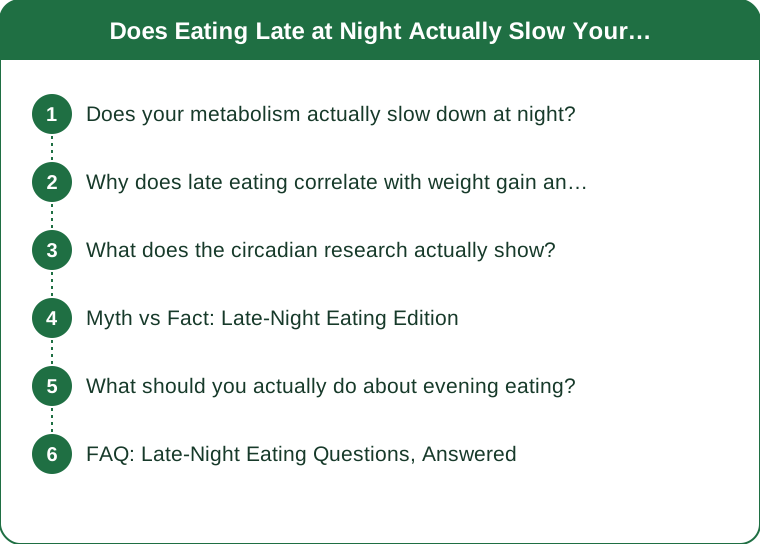
Does your metabolism actually slow down at night?
Barely, and less than the myth needs it to.
Your resting metabolic rate — the energy cost of being alive — continues around the clock. During sleep it dips only modestly below daytime resting levels, and in parts of the night, particularly REM sleep, the brain’s energy use is close to waking levels. The picture of a body powering down at sunset and storing everything that arrives after is simply wrong.
Digestion also proceeds fine at night. The thermic effect of food — the energy cost of digesting a meal, roughly 10 percent of intake — occurs whenever you eat. A 300-calorie snack costs about the same to process at 10pm as at 10am.
What controlled studies consistently find is that total intake and diet quality predict weight change; adding meal timing explains only a small additional slice. In tightly controlled feeding studies where calories are locked, shifting the same food later produces modest metabolic differences, not the wholesale storage-mode switch the 8pm rule implies.
So the honest answer to the headline is mostly no. The interesting question is why late eaters still tend to gain — and that answer has three parts, none of which is a slowing metabolism.
Why does late eating correlate with weight gain anyway?
Because of what, how, and how much — not when, exactly.
What: nobody roasts vegetables at 10pm. Evening food skews hard toward packaged, dense, salty-sweet snack formats. The calories that arrive after dinner are disproportionately the least filling, most overeatable ones in the house.
How: attention is elsewhere. Late eating is screen eating — and eating while distracted reliably increases intake and blunts memory of having eaten, which raises hunger the next day. The 10pm bowl is rarely eaten at a table with attention; it is a hand-to-mouth loop with a show.
How much: fullness signals are working against a tired brain. Willpower and interoception both degrade with fatigue. The same person who stops at a sensible portion at lunch keeps going at night, because the stop signal is quieter and the day’s accumulated depletion is louder.
Run those three together and the correlation explains itself: late-night calories are extra calories from easy foods eaten inattentively past fullness. The 8pm rule works by amputating that entire category — it was never the clock, it was everything the clock took with it.
Which is also why the rule fails people whose late meal is a real dinner after a shift: they cut nothing problematic and just get hungrier.
What does the circadian research actually show?
That timing has real but modest biological effects — worth knowing, not worth panicking over.
Your glucose tolerance is genuinely worse in the late evening: the same meal produces a higher, longer blood-sugar rise at 10pm than at 10am, because insulin sensitivity follows a daily rhythm and melatonin onset overlaps poorly with incoming carbohydrate. Over years, chronically loading calories into your least-tolerant hours is plausibly meaningful, and it is why shift workers show elevated metabolic risk even at matched intakes.
Controlled studies that shift the same calories later also find small decreases in energy expenditure and fat oxidation, and appetite-hormone changes — slightly higher hunger signaling the next day. The measured effects are consistent in direction and modest in size: a thumb on the scale, not an anvil.
The practical translation: front-loading helps at the margin. Eating your larger meals earlier and keeping the last two to three hours before bed light works with your rhythm instead of against it. That is a real optimization for people whose fundamentals — total intake, protein, sleep, movement — are already in order.
What it is not is a moral deadline. A balanced dinner at 9pm because life ran long is a rounding error. The research indicts the chronic pattern of night-loaded eating, not the Tuesday you ate late.

Myth vs Fact: Late-Night Eating Edition
Myth: Food after 8pm turns to fat. Fact: Fat storage is governed by your overall energy balance across days, not the hour a given bite lands. The 8pm rule helps people by deleting a snacking category, not by beating a metabolic curfew.
Myth: You should go to bed hungry to lose weight. Fact: Genuine hunger at bedtime fragments sleep, and short sleep raises next-day hunger hormones and cravings — a strictly worse trade. A light protein-forward snack that quiets real hunger protects the sleep that regulates tomorrow’s appetite.
Myth: Breakfast like a king, dinner like a pauper is proven law. Fact: Front-loading shows modest advantages in some trials and matters far less than totals and food quality. People who thrive on early big meals should keep them; forcing a large breakfast on someone who is never hungry at 7am adds calories, not virtue.
Myth: Late-night carbs are the specific villain. Fact: Evening glucose handling is somewhat weaker, but a bowl of berries at 9pm is not a problem in any realistic diet. The actual late-night carb problem is that late-night carbs are usually chips — a food-choice issue wearing a timing costume.
Myth: If I ate late, the damage is done and the night is ruined. Fact: One late snack is trivially recoverable. The all-or-nothing reaction — writing off the night and doubling down — is the part that costs something.
What should you actually do about evening eating?
Match the fix to your actual pattern.
If you snack out of ritual, not hunger: change the environment, not the clock. The couch snack is a cue-driven loop — replace the trigger with tea, sparkling water, or brushing your teeth after dinner, and keep the trigger foods out of easy reach. This is the highest-yield case, and it is behavioral, not metabolic.
If you are genuinely hungry at night: audit the day. Chronic 9pm hunger usually means thin daytime protein or an undersized dinner — under-eat all day and the evening bill arrives with interest. Add 25 to 30 grams of protein at dinner and the night hunger typically fades within a week.
If your schedule forces late dinners — shifts, late workouts, long commutes: eat the real meal without guilt, keep it balanced, and leave roughly two hours before lying down for the sake of reflux and sleep quality more than weight. Late-training athletes in particular should not skip post-workout food to honor a folk rule.
If you want the circadian edge: shift the day’s center of gravity earlier — bigger lunch, moderate dinner, light final hours. As evenings start darkening earlier over the coming weeks, an earlier dinner gets easier to keep, and pairing it with a consistent sleep time compounds both habits.
Across all four: protect sleep first. Nothing about meal timing outweighs what a short night does to next-day appetite.
FAQ: Late-Night Eating Questions, Answered
Is it bad to work out at night and then eat afterward?
No — post-exercise eating supports recovery regardless of hour, and skipping it to obey a clock rule is counterproductive. Keep the meal moderate, favor protein plus carbs, and give yourself a buffer before bed if heavy meals disrupt your sleep.
What are the best options if I need something before bed?
Something light, protein-leaning, and low-effort to stop eating: Greek yogurt, cottage cheese, a banana with a spoon of peanut butter, or warm milk. The goal is quieting hunger, not a fourth meal — and portioning it in the kitchen beats bringing the container to the couch.
Does late eating affect sleep even if weight is not my concern?
Yes — large or spicy meals within two to three hours of bed increase reflux risk and can fragment sleep, and poor sleep circles back into next-day appetite. The two-hour buffer is the most defensible version of any evening food rule.
Do intermittent fasting windows fix late-night eating?
They can, for people whose main leak is after-dinner grazing — an eating window is the 8pm rule with better branding, and it works by the same deletion mechanism. It fails the same people too: anyone whose late eating comes from under-eating earlier just gets hungrier. The window is a container, not a cure.
This is general information, not medical advice.
TL;DR:
- Metabolism does not meaningfully slow at night; a late calorie digests like an early one. The 8pm rule works by deleting snack calories, not by beating a curfew.
- The real late-night risks are behavioral — dense foods, distracted eating, tired fullness signals — plus modest circadian effects on glucose handling and overnight fat use.
- Fix the pattern you actually have: ritual snackers change cues, hungry snackers fix daytime protein, late-shift eaters eat real dinners guilt-free with a two-hour bed buffer.
- Front-loading calories earlier is a legitimate marginal optimization once totals, protein, sleep, and movement are handled — and never before.
Stop auditing the clock and audit the couch. The hour was never the problem; the bag that opens at that hour usually is.
Keep Reading
This article is for general informational purposes only and is not medical advice. Always consult a qualified health professional for guidance specific to you.