Does a Standing Desk Actually Increase Your Daily Calorie Burn?
Quick Answer: Standing burns roughly 0.15 extra calories per minute compared to sitting for an average adult, which works out to about 9 calories per hour, or 54 calories over a six-hour standing workday. That is real but small — about one apple. The genuine benefit of a standing desk is that standing people fidget, shift, and walk more, and that downstream movement is worth considerably more than the standing itself.
The number quoted in standing desk marketing is usually somewhere between 170 and 400 extra calories a day. The number from metabolic chamber studies is around 50. Both cannot be true, and the gap is where all the interesting information lives.

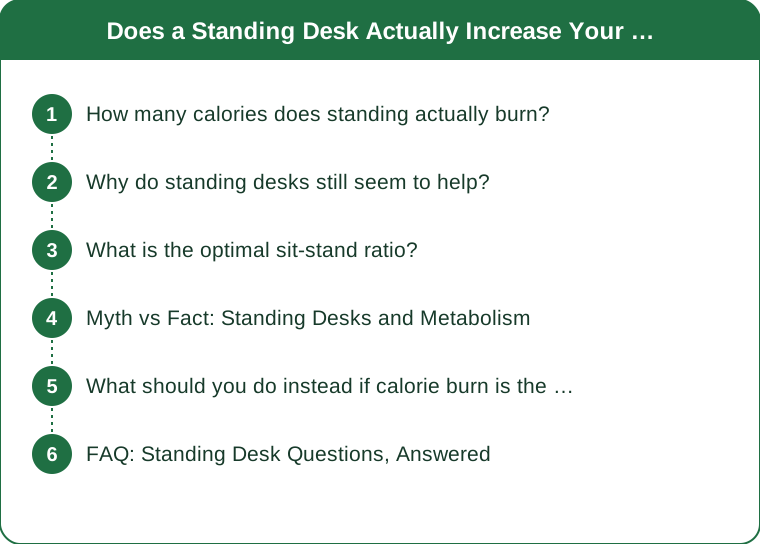
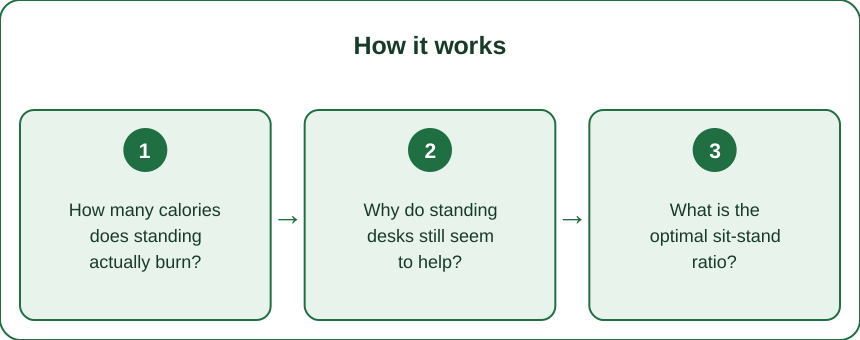
How many calories does standing actually burn?
The best data comes from studies that measured oxygen consumption directly rather than estimating.
A 2018 meta-analysis pooling 46 studies found the difference between sitting and standing was 0.15 calories per minute for an average 65kg adult. Scale that: 9 calories an hour, 54 calories across six hours of standing, roughly 250 calories across a five-day work week.
For a heavier person the number rises somewhat — energy cost scales with body mass, so a 90kg adult might see closer to 0.2 calories per minute. Still under 80 calories for a full standing day.
Compare that to a 20-minute walk, which burns around 90 to 110 calories for the same person. A short walk beats an entire day of standing. That is the honest framing, and it is not what the desk manufacturer put on the box.
Where did the bigger numbers come from? Mostly from older studies with small samples, or from calculations that quietly assumed standing plus movement rather than standing still.
Why do standing desks still seem to help?
Because standing changes behavior, and behavior is where the calories are.
When you are seated, moving requires a decision. When you are already upright, movement is nearly free — you shift your weight, you take two steps to the printer, you pace during a phone call. This is NEAT, non-exercise activity thermogenesis, and it varies between individuals by up to 2,000 calories a day.
Studies that track accelerometer data rather than just standing time consistently find standing-desk users accumulate more steps and more postural changes across the day. The desk is a trigger for movement, not a calorie burner in itself.
There is also a fatigue effect that works in your favor. Standing all day is genuinely tiring, and tired legs make you move differently — which is why the sit-stand alternating pattern outperforms full-time standing for both comfort and total activity.
So the desk works. It just does not work through the mechanism the advertising claims.
What is the optimal sit-stand ratio?
Current occupational health guidance points to accumulating two hours of standing and light activity during an eight-hour workday, building toward four hours.
In practice that means alternating in blocks rather than standing until you cannot take it. A common pattern that works: 30 minutes standing, 30 minutes sitting, repeating. Some people prefer 45/15 or standing for the first half of each hour.
Do not go from zero to six hours of standing on day one. Lower back and foot discomfort from a sudden switch is the single most common reason standing desks end up permanently in the down position by week three.
A few practical details matter more than the ratio. Get an anti-fatigue mat — hard floors are the main source of foot pain and the mat costs $30 to $60. Wear shoes rather than standing barefoot on tile. And set the desk so your elbows are at roughly 90 degrees and the screen top is at eye level, or you will trade a back problem for a neck problem.

Myth vs Fact: Standing Desks and Metabolism
Myth: A standing desk burns 300 calories a day. Fact: Around 50 to 80 for a full standing workday, based on direct measurement. The larger figures come from studies that bundled standing with walking.
Myth: Standing all day is better than alternating. Fact: Prolonged standing carries its own risks — varicose veins, lower back load, and foot pain — and studies find alternating produces better comfort scores and better sustained use. More is not better past about four hours.
Myth: Standing counteracts a sedentary lifestyle. Fact: Standing is still sedentary in metabolic terms. It does not produce the muscle contraction pattern that improves glucose handling the way walking does. The person who sits all day but walks 30 minutes at lunch is in better shape than the person who stands still for eight hours.
Myth: You will lose weight from switching to a standing desk. Fact: 250 calories a week is about 3.7 pounds of theoretical fat loss over a full year, before any appetite compensation — and appetite compensation is real. Treat it as a posture and energy intervention, not a weight-loss one.
What should you do instead if calorie burn is the goal?
Stack small movement into the day, and use the desk as one of several triggers.
Walk during calls. A 20-minute audio call taken while walking adds more than three hours of standing. If your job includes several calls a week, this is the single highest-yield change available.
Take a five-minute movement break every hour. Set a timer. Five minutes an hour across eight hours is 40 minutes of light activity, which lands in the 150 to 200 calorie range and does far more for glucose control than standing.
Use the stairs deliberately. Not as a fitness plan, just as a default. Three flights, four times a day, is meaningful over a year.
Park further away or get off a stop early. The classic advice survives because it works, and it costs no willpower once it becomes the route you take.
As the weather cools over the next month, outdoor walking gets genuinely pleasant again — worth building the lunchtime walk habit now while it is easy, so it is established before winter tests it.
FAQ: Standing Desk Questions, Answered
Does a treadmill desk burn significantly more?
Yes, substantially. Walking at 1.5 mph while working burns roughly 100 to 130 extra calories per hour compared to sitting — more than ten times the standing figure. The trade-off is that fine motor tasks like detailed typing get measurably harder.
Is standing better for blood sugar after meals?
Somewhat. Standing after a meal produces a small improvement in post-meal glucose compared to sitting, but a 10-minute walk produces a much larger one. If you can only do one thing after lunch, walk.
How long before standing feels comfortable?
Two to four weeks for most people if you build up gradually. Foot and calf discomfort in the first week is normal; sharp lower back pain is not, and usually means your desk height or monitor position needs adjusting.
This is general information, not medical advice.
TL;DR:
- Standing burns about 0.15 calories per minute more than sitting — roughly 54 calories over a six-hour standing day.
- The real benefit is behavioral: standing people fidget and walk more, and that NEAT is worth far more than the standing.
- Alternate in 30-minute blocks and build up over weeks; full-time standing backfires on comfort and adherence.
- If calorie burn is the actual goal, walking calls and hourly five-minute breaks beat the desk by a wide margin.
Keep the standing desk. Just stop expecting it to do a walk’s job — and put a 20-minute walk somewhere in your afternoon while the weather still makes that easy.
Keep Reading
This article is for general informational purposes only and is not medical advice. Always consult a qualified health professional for guidance specific to you.